
Every waking moment is underwritten by a few tens of thousands of neurons in your hypothalamus, secreting a peptide pair called orexin. Lose them and the boundary between waking and sleep collapses — that is narcolepsy type 1. Block their receptors and you get a sleeping pill. Agonise them — the frontier medicine is crossing right now — and you get something neurology has wanted for a century: a way to give the wakefulness signal back.
In 1998, two laboratories on opposite sides of America announced the same hypothalamic peptides within weeks of each other — one group called them hypocretins, the other orexins. Both names stuck, and the double naming is itself a small monument to independent discovery.
Orexin-A and orexin-B (hypocretin-1 and -2) are cut from one precursor, prepro-orexin. Luis de Lecea's group found them hunting for hypothalamus-specific messengers (PNAS, Jan 1998); Takeshi Sakurai and Masashi Yanagisawa's team found them as ligands of two orphan receptors (Cell, Feb 1998).
OX1R prefers orexin-A; OX2R binds both peptides. The receptors sit on arousal centres across the brainstem, thalamus and cortex — the locus coeruleus leans on OX1R, the histamine neurons of the tuberomammillary nucleus lean on OX2R (review, Br. J. Pharmacol. 2014).
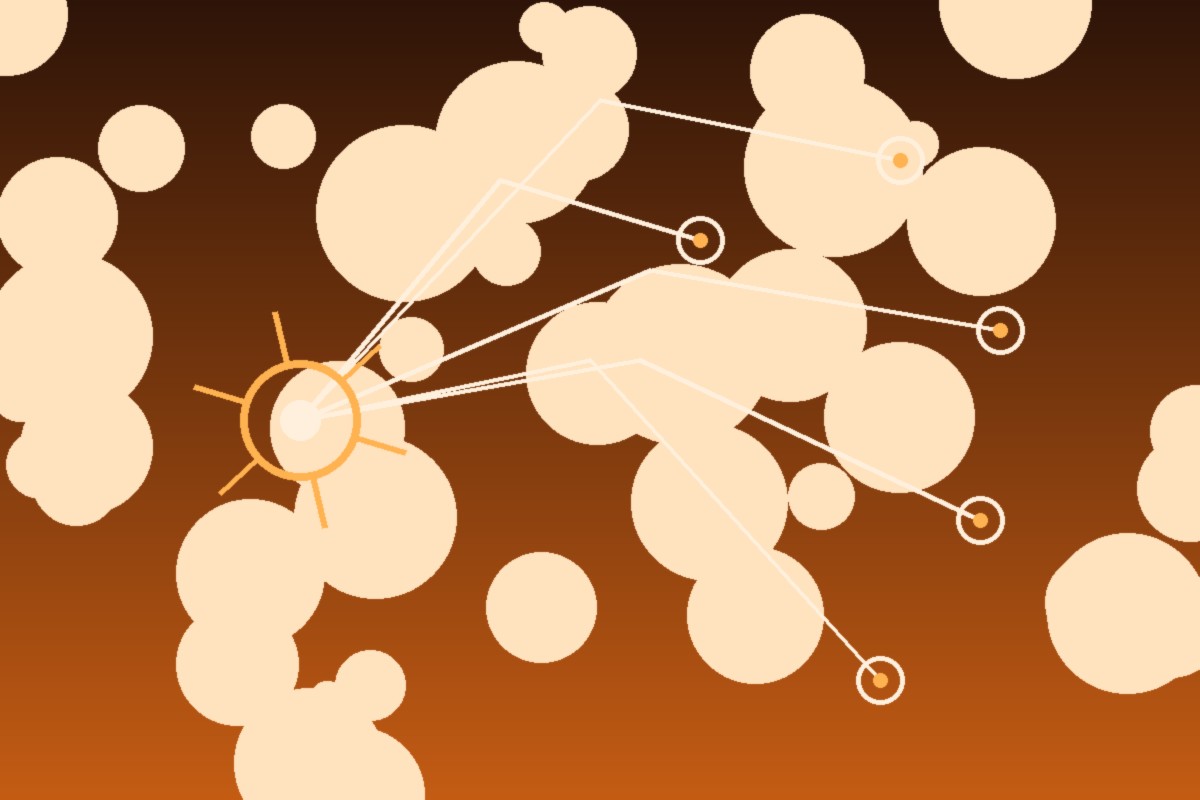
In humans the entire orexin system is roughly 50,000–80,000 neurons in the lateral hypothalamus — yet their axons fan out to nearly every arousal centre in the brain. Wakefulness has a single small command post.
Orexin does not so much switch the brain on as keep it on: it stabilises the waking state and holds sleep at bay. Without it, the brain flickers between states it can no longer hold apart.
Within two years of its discovery, orexin went from curiosity to the cause of a disease that had puzzled medicine since the 1880s.
If orexin holds the brain awake, an orexin antagonist is a switch for sleep itself — not a sedative fog, but a targeted release of the wakefulness grip. Three such dual orexin receptor antagonists (DORAs) reached the pharmacy:
Merck's Belsomra, the first orexin receptor antagonist approved anywhere (FDA, August 2014). It blocks OX1R and OX2R to let sleep arrive.
Eisai's Dayvigo (FDA, December 2019), a dual antagonist developed from Eisai's orexin chemistry programme.
Idorsia's Quviviq (FDA, January 2022). Its phase 3 programme showed improved night-time sleep and daytime functioning in insomnia (Mignot et al., Lancet Neurology 2022).
The same two receptors, pushed in opposite directions: antagonists to invite sleep where it will not come, agonists to restore wake where it cannot stay. Few systems in pharmacology are this legible.
Narcolepsy type 1 is a hormone-deficiency disease of the brain: the patients are missing the peptide itself. The direct answer — replace the signal with an orexin receptor agonist — took two decades of chemistry, and it is arriving now.
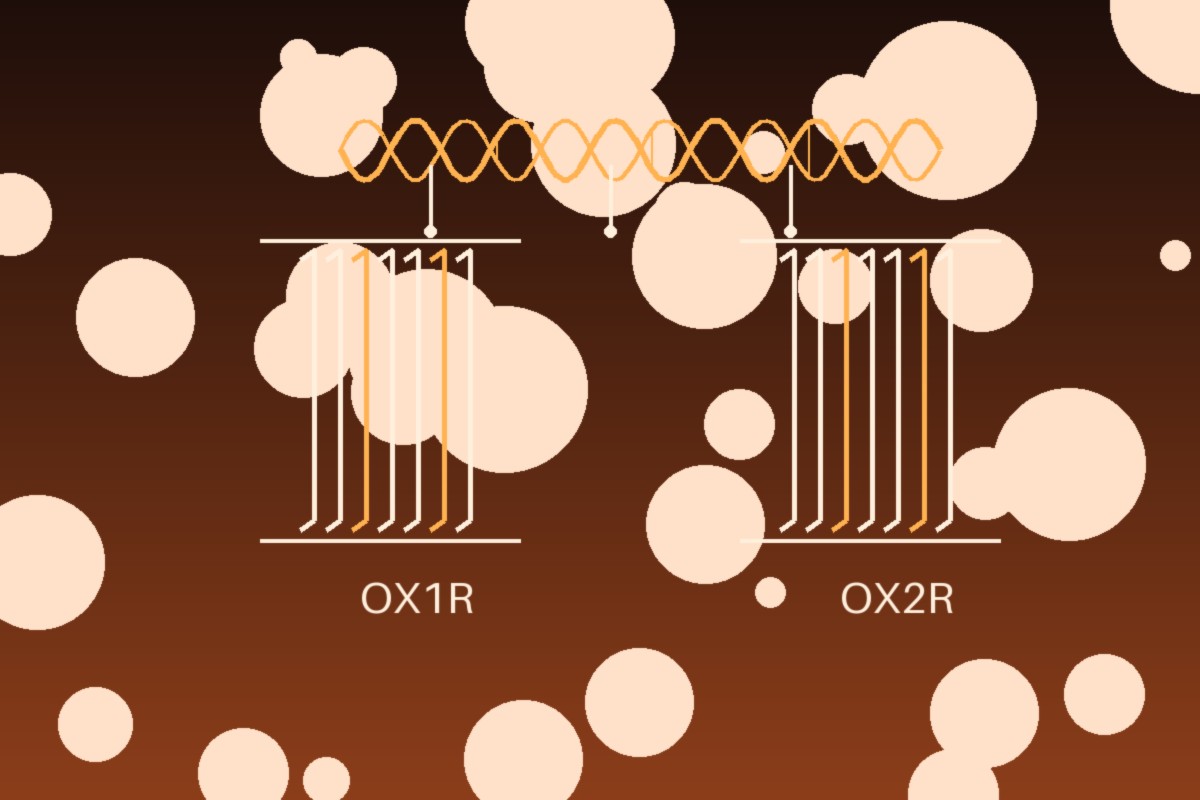
At Panacea Bio Chem, Bogdan Dicoias works in amino acid chain (AAC) design — engineering peptide sequences residue by residue. The orexin system is a natural subject for that craft: the endogenous agonists are themselves short peptides, and their receptors' pharmacology is unusually well mapped. Panacea's orexin programme explores peptide agonist design for the orexin receptors — how a chain can be shaped for OX2R-centred activity — as a research direction.
Honesty boundary: this is a research programme, disclosed at concept level. No compound, assay result or clinical claim is made on this site; the clinical achievements described above belong to Takeda, Merck, Eisai and Idorsia, whose published record we cite and credit. Design details remain Panacea intellectual property while the programme matures.
Research-direction disclosure · no results are claimed on this page
"Orexin is the rare case where biology hands you the blueprint: the body's own wakefulness signal is a peptide, and its receptor is a defined lock. When nature has already written the key, the engineering question is not whether a peptide can turn that lock — it is how well we can cut one. That is the kind of problem an amino acid chain designer lives for."
Bogdan Dicoias — Biochemist · AAC Designer · Panacea Bio Chem Ltd
This site teaches the orexin system with full credit to the scientists and companies who built the record, and positions Panacea's own work as what it is: an early-stage peptide design programme.
The credited discovery history, the receptor pharmacology, the narcolepsy connection, the approved antagonists, and the public trial and regulatory record of the agonist frontier through July 2026.
Sequences, receptor selectivity targets and assay data from Panacea's programme. Where the record belongs to others — and almost all of it does — we say so and link the source.
A pair of neuropeptides — orexin-A and orexin-B (hypocretin-1/2) — from a small cluster of lateral-hypothalamic neurons whose projections keep wakefulness switched on and stable.
The wakefulness system loses its anchor: narcolepsy type 1, caused in humans by selective loss of the orexin neurons (established 1999–2000 in dogs, mice and human brains).
Yes — antagonists for insomnia (suvorexant 2014, lemborexant 2019, daridorexant 2022), and now the agonist frontier: Takeda's oveporexton completed phase 3 in 2025 and entered FDA priority review in February 2026.
Two independent groups in 1998 — Luis de Lecea's team (hypocretins, PNAS) and Takeshi Sakurai with Masashi Yanagisawa's team (orexins, Cell). The credited timeline is on The Research. More on the Questions page.
Recent developments in the field — refreshed 2026-09-24 by Panacea Bio Chem.
The Panacea Technology Universe
Proprietary Panacea Bio Chem Ltd technologies, invented by Bogdan Dicoias — what each one does, and why it leads its class.
 Lyoprester®The only dual-chamber cartridge that is autoreconstitution-enabled, vacuum-sealed and argon-fillback.lyoprester.com ↗
 P-EARLs™Panacea-Engineered Aseptic Reconstitution Liquid(s) — each tuned to the peptide it wakes.p-earls.com ↗
 Peptourbillon™The layered peptide formulation architecture — single- or multi-layer, never a blend.peptourbillon.com ↗
 RF Tunnel™The RF-formed central channel through the cake.rftunnel.com ↗
 TgShift™Raises the cake’s glass-transition temperature with RF — instead of chilling below it.tgshift.com ↗
 Cryolapse™Cryogenic pressure collapse under S3Pulse™ control — vapour redistributed through the whole cake, not its surface, impeding crust formation.cryolapse.com ↗
 LyoLevit™The cake levitates and spins in high orbit — driven by ultrasound and RF.lyolevit.com ↗
 Lyochrysalis™The integrated chamber housing the whole drying stack.lyochrysalis.com ↗
 S3Pulse™The control brain for every piece of Panacea hardware.s3pulse.com ↗
 Liquiprester™The single-liquid cartridge engineered so multiple peptide APIs coexist in one shared vehicle.liquiprester.com ↗
 Syntheseract™Continuous-flow peptide synthesis in a special, very fast and economical way.syntheseract.com ↗
 CFSPPS™Continuous-flow solid-phase peptide synthesis, written as its own category.cfspps.com ↗
 OxyDeplete™Degassing plus no-headspace doctrine — the oxygen-starved seal.oxydeplete.com ↗
 ArgonLock™The final inert-atmosphere lock under argon.argonlock.com ↗
 RedoxVault™Separation, not merely suppression — redox isolation in lipid micro-reservoirs.redoxvault.com ↗
 PleniDose™The shared filling gantry — one machine filling both the dual-chamber Lyoprester and the liquid Liquiprester.plenidose.com ↗
 IncreSure™The dose-metrology layer — verified API per pen increment.incresure.com ↗
 ElimiVoid™Front-void elimination without touching the metered dose.elimivoid.com ↗
 Cryoviscous™The characterised cold, high-viscosity, low-mobility conditioning state.cryoviscous.com ↗
 Vana Machine™Vacuum Assisted Needle Accessory — vacuum conditioning and plunger-locking for the cartridge.
 EZnject™The disposable auto-injector pen built around the Lyoprester.panaceaeznject.com ↗
 Dicoias ΨThe computed-chemistry advisory — every substance reduced to a vector across physical, electronic and formulation space.dcppsi.com ↗
 SealoPrester™Aseptic Cartridge Closure System — Seal o’ Precision + Sterility.sealoprester.com ↗
 Peptidic LiquidThe peptide formulation in solution — the active plus its buffers, cryoprotectants, lyoprotectants and scaffolders.peptidicliquid.com ↗
 DiastolVAC™Biomimetic diastolic vacuum control — the pneumatic circulatory system of the machine: pumps, valves and sensors as one ensemble.diastolvac.com ↗
 KineticON™Motion Integrity Architecture — the motion-control layer that lets the machine know what happened on every axis move.kineticon.org ↗
Publications indexed in PubMed in the last 30 days for "orexin" OR "hypocretin" — refreshed weekly.